Kristen M. Driskill, Ed.D.

Teaching
Professor Kristen Driskill
St. John Fisher University
-
Associate Professor of Inclusive Education
-
Department of Inclusive Education
-
School of Education


"To teach in a manner that respects and cares for the souls of our students is essential if we are to provide the necessary conditions where learning can most deeply and intimately begin."
-bell hooks
Inclusive Teaching
A fundamental part of my teaching is creating an inclusive environment in which all students are supported and feel a sense of belonging. Creating an equitable environment in my classroom is paramount, from co-creating my course syllabi, course norms, and course expectations with students, to representing diverse perspectives in course readings, to providing choice and flexibility in course assessments.
In addition, much of my teaching involves reflection. Not only do I want my teacher candidates to have positive and successful experiences as students, but I want them to be able to provide the same for their future students. We engage in a lot of discussion, role-play, modeling, and experimentation in the field, all in an effort to try things out and help my students come to learn who they are as teachers.
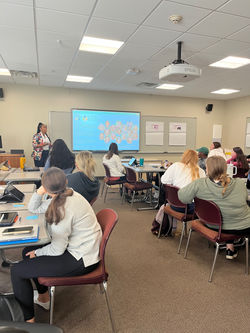
From Spring 2025 through Fall 2025, I am one of two Inclusive Teaching Faculty Fellows at St. John Fisher University. Through this role, I am able to share my expertise with colleagues by offering workshops, facilitating events, consulting and coaching faculty, and supporting various projects across the University. I also facilitate a course on inclusive teaching practices for all new faculty as part of the University's Teaching Excellence Program.
"Diversity is being asked to the party, Inclusion is being asked to dance."
— Verna Myers
 |  |  |  |
|---|---|---|---|
 |  |  |  |
 |  |  |  |
 |  |
Courses Taught
Given my diverse background, I teach a wide range of courses. In initial certification programs at both the Undergraduate and Graduate levels, I teach courses focused on methods in math instruction and social studies instruction, adolescent literacy, ed tech, and education for social justice. I also teach graduate courses in our Masters in Literacy program.
EDUC 302
Differentiated Curriculum, Instruction, and Assessment in Social Studies
This course is designed to support candidates in the planning and implementing of effective social studies instruction in diverse classrooms. The focus of this course is to help candidates further develop their personal education philosophy and vision of a social studies classroom; an understanding of social studies, including the ten thematic NCSS Standards; pedagogical skills; and their capacity to create learner-centered, meaningful, challenging, and active instruction for all students. This course also features best practices in English Language Arts across the curriculum, classroom management, instructional strategies to help all students learn, and the use of technology to enhance teaching and learning. Candidates demonstrate knowledge of the Common Core State Standards and local curricula in order to enhance pedagogy and student learning. This course includes a field experience.
EDUC 315
Content Area Literacy
This course is designed to highlight the role of literacy acquisition and application within the content areas. Literacy and writing strategies are presented in conjunction with New York State Common Core Learning Standards. The varying and various contexts surrounding the nature of reading and reading instruction, the conceptual ideas underlying the teaching of reading in the content areas, and reading skills and strategies that help students understand specific subject matter content are explored. An additional focus of this course is to help literacy and subject-area teachers address the needs of diverse learners through culturally relevant pedagogy and curriculum, the use of multicultural materials, alternative and adaptive methods, and the use of technology. This course is designed to introduce literacy skills that can be incorporated with content-area teaching. This course includes a field experience.
EDUC 345
Differentiated Curriculum, Instruction, and Assessment in Mathematics
Building on the foundation for STEM education laid in EDUC 335, this course brings a focus on the differentiated teaching and learning of elementary mathematics. Teachers of elementary mathematics need a special kind of understanding of mathematical content. They not only need to understand the mathematics that they teach, but they also need to understand how various children learn that mathematics. From the time a child first encounters a new mathematical idea to the time that that child is able to make fluent and mature use of that mathematical idea, that child’s growth constitutes a “trajectory” of learning. This course focuses on the special mathematical knowledge that teachers need in order to facilitate all children’s learning trajectories in the various areas of mathematics. The central mathematical concepts articulated in the Next Generation State Standards for Mathematics form the basis for this course.
EDUC 415
Differentiated Literacy Instruction: Middle Childhood and Adolescence
This course is a continuance of EDUC 315. This course explores a variety of literary works, including multicultural and global writings, for middle-childhood and adolescent learners. Additionally, this course seeks to expose teacher candidates to ideas for effectively involving middle-childhood and adolescent readers of diverse backgrounds in the literacy experience and to the use of technology and information literacy to support instruction and learning. This course provides students with an opportunity to actively examine and evaluate instructional strategies and practices for literacy instruction at the middle-childhood and adolescent levels. This course includes a field experience.
EDUC 424
Education for Social Justice
This course is designed to broaden candidates’ understanding of diversity and social justice and how these concepts relate to educating all students in light of society, tradition, and conventional wisdom. Particular emphasis will be placed on the following: developing cross-cultural skills and understandings to increase effective communication with all education stakeholders, including students and families; understanding the importance of changing and competing interpretations of world events to develop positive collaborations among all stakeholders, including families, students, teachers and other education professionals; understanding how citizenship includes the exercise of personal responsibilities; and the historical, social, political, and educational contexts of diversity in American society.
GSED 515
Educational Technology
The use of technology to improve instructional practice is an essential skill for all teachers. This course is designed to support teacher candidates in developing a knowledge and skill base in educational and assistive technology. The long-term goal is to ensure future teachers can make effective use of available technologies to enhance cognitive and physical development, differentiated instruction and planning, to improve personal productivity, and to support all students, including students with exceptional learning needs (ELN), fully in a learning environment. This course teaches students to locate, use and adapt a variety of assistive technology devices and software tools and to apply these technologies in a wide range of integrated educational settings. The use of assistive technology as it relates to education, communication, social engagement, recreation, and mobility for individuals with disabilities will be explored.
GAED 530
Differentiated Curriculum, Instruction, and Assessment in Middle School
GAED 530 focuses on differentiated curriculum, instruction, and assessment in schools serving young adolescents, grades 5-9. This course is based on the principle that young adolescents learn the most when teachers understand the characteristics of the age group and instruct in ways that address students’ developmental needs. As such, GAED 530 introduces candidates to the philosophy and organizational structures of school in the “middle.” The course reinforces and deepens candidates’ prior knowledge of cognitive, physical, psychological, and socio-emotional development; active learning strategies; and positive learning environments. It builds candidates’ abilities to differentiate and personalize learning for young adolescents through immersion in an exemplary middle school setting. This course is a requirement for the Middle School Extension of Childhood and Adolescent Certifications.
GRDG 626
Language, Literacy, and Diversity
In this course, students will examine theory and research around the concept of diversity and its relation to literacy learning. We will draw on Critical Race Theory, sociocultural theory and the concept of discourse communities to conceptualize diversity and to understand the educational challenges and opportunities presented by diversity in relation to literacy learning. Questions about the unique challenges of teaching literacy in a complex classroom will be raised, and consideration will be given to different ways of investigating those questions. Also, questions with regard to how research has contributed to our thinking and methods of teaching literacy to diverse student populations will be examined.
GRDG 640
Administration and Supervision of Reading and Writing Programs
This course will deal with issues related to both district supervisors and school-based coordinators of reading programs. This course will provide proficiency in organizing and enhancing literacy programs. Emphasis will be placed on communicating literacy information and assessment results to parents, caregivers, and school personnel. In addition, candidates will explore techniques for analyzing and improving curriculum and instruction in alignment with the Common Core State learning standards. Effective leadership skills will be examined.


